




Organic SEO is still one of the most effective—and affordable—strategies for long-term online presence in a world of paid advertisements and algorithm updates. Knowing organic SEO is important for creating a long-lasting online presence, whether you’re a blogger, marketing expert, or small business owner.
What Is Organic SEO?
Organic SEO (Search Engine Optimization) refers to the process of improving a website’s visibility in unpaid search engine results pages (SERPs). Unlike paid search advertising, where you bid for placement, organic SEO earns rankings through relevance, authority, and technical excellence.
When someone searches for a product, service, or answer on Google, the results that appear below the paid ads are organic listings. Ranking high in these results requires a deliberate, multi-faceted strategy — and that strategy is organic SEO.
Why Does Organic SEO Matter?
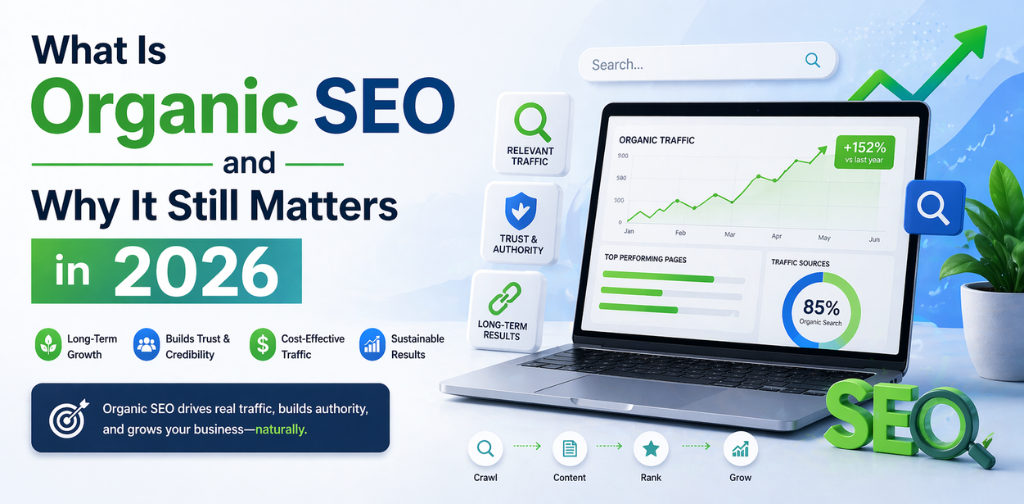
The data speaks for itself. Research continuously demonstrates that organic search surpasses all other channels, including social media, email, and paid advertising, in generating over 50% of all website visitors. Because organic results are earned rather than affected by a marketing budget, users have more faith in them.
Beyond trust, organic SEO yields increasing benefits. Unlike a paid advertisement, which vanishes as soon as your budget runs out, a well-optimized page can draw visitors for months or even years after it is published. This makes organic SEO an indispensable investment for companies aiming for long-term growth.
The Core Pillars of Organic SEO
1. Keyword Research
Keyword research is the first step in any successful organic SEO plan. This entails determining the precise terms and phrases that members of your target audience enter into search engines. Finding keywords with significant search intent, respectable traffic, and controllable competition is the aim.
Research on keywords nowadays goes beyond single terms. Long-tail keywords, which are precise, multi-word phrases like “best organic SEO strategies for small business,” frequently result in higher conversion rates since they draw in people who are well-informed.
2. On-Page Optimization
On-page optimization guarantees that your material is organized in a way that search engines can comprehend after you have your keywords. This includes:
- Title tags and meta descriptions — crafted to include your target keyword and entice clicks
- Header tags (H1, H2, H3) — used to organize content and signal relevance
- Keyword placement — naturally woven into the body, introduction, and subheadings
- Internal linking — connecting related pages to distribute authority across your site
- Image alt text — making visuals accessible and crawlable
3. High-Quality Content
Content is the backbone of organic SEO. Search engines prioritize content that genuinely helps users — content that is accurate, original, well-structured, and comprehensive. Google’s E-E-A-T framework (Experience, Expertise, Authoritativeness, and Trustworthiness) underscores that quality matters far more than keyword stuffing ever did.
Publishing consistent, valuable content positions your website as an authority in your niche — and authority is what earns rankings.
4. Technical SEO
Behind every great piece of content is a technically sound website. Technical SEO covers page speed, mobile-friendliness, crawlability, secure HTTPS connections, structured data markup, and clean URL structures. If search engine bots can’t crawl and index your site efficiently, even the best content won’t rank.
5. Link Building
Backlinks — links from other reputable websites pointing to yours — remain one of the strongest ranking signals in organic SEO. Earning high-quality backlinks through guest posting, digital PR, original research, or shareable resources signals to search engines that your content is trustworthy and worth promoting.
Organic SEO vs. Paid Search
While paid search (PPC) delivers instant visibility, it comes at a constant cost. Organic SEO, by contrast, requires upfront effort but generates lasting results. The most effective digital marketing strategies use both paid search for quick wins and organic SEO for long-term growth.
Getting Started With Organic SEO
If you’re new to organic SEO, start small: audit your existing content, identify your most relevant keywords, optimize your top pages, and publish one genuinely helpful article each week. Working with a trusted FairSEO Service can also accelerate this process—giving you expert guidance on technical fixes, content gaps, and link-building opportunities without the bloated agency price tag. Results won’t come overnight, but with consistency, organic SEO will become your most reliable source of traffic, leads, and revenue.
In 2026 and beyond, the brands that invest in organic SEO—whether independently or through a reliable FairSEO Service (fairseoservice.com)—are the ones that will own their market without paying for every single click.