



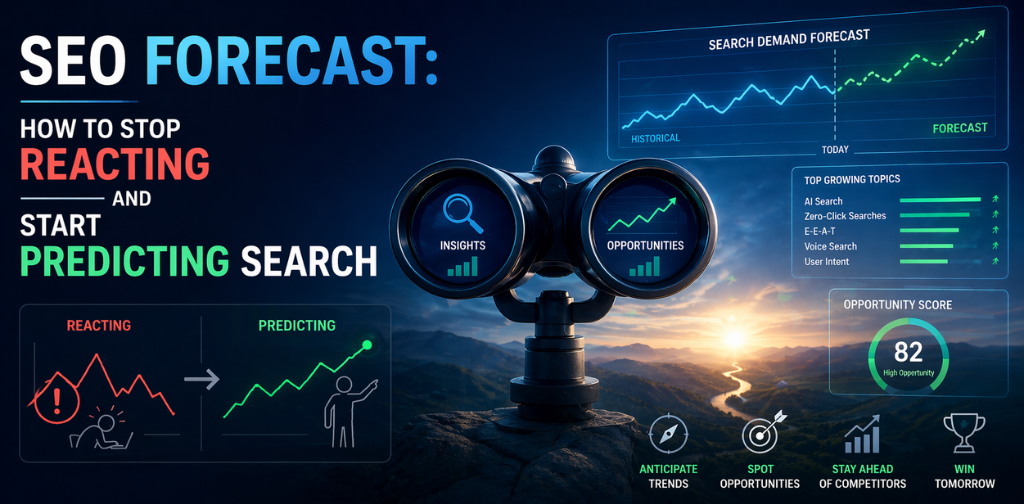

Most SEO strategies are built looking backward — chasing keywords that peaked six weeks ago, publishing content about trends competitors already own. That approach is becoming a liability. The 2026 SEO forecast isn’t just about what’s changing in search — it’s about how the smartest brands are shifting from reactive to predictive SEO, using data, AI, and a sharper understanding of user intent to get ahead of demand before it peaks.
Why Reactive SEO Is Losing Ground?
The traditional SEO loop — research keywords → create content → build links → wait for rankings — takes months. By the time results appear, the competitive landscape has already moved. The problem is worse now. An increasing percentage of informational searches are answered by AI Overviews without directing consumers to any websites. More than 60% of all Google searches are zero-click. The keywords you’re fighting for today are increasingly being answered before anyone reaches your page.
Brands that identify rising topics early — while search volume is still building — publish authoritative content before the space gets crowded. They rank faster, build authority cheaper, and get cited by AI systems as the primary source. The forecast is clear: timing is the new competitive advantage.
What Predictive SEO Actually Means?
Predictive SEO is a methodology — the practice of using data signals to anticipate where search demand is heading, then building content and authority to meet it before it peaks. A keyword implying informational intent today (“what is AI SEO?”) often evolves into commercial intent tomorrow (“best AI SEO agency,” “AI SEO pricing”). Brands that map this intent journey in advance and build content across it consistently outperform those targeting only the peak-volume, high-competition stage.
5 Signals That Tell You Where SEO Is Heading
1. Velocity Over Volume— A keyword with 500 monthly searches but 300% growth over 90 days is more valuable than one with 10,000 flat searches. Trajectory data is provided by tools like Semrush, Exploding Topics, and Google Trends. Finding the keywords that are going to become popular is more important than finding the biggest ones.
2. Intent Cluster Mapping— Keyword research now produces intent clusters—groups of 40–150 related queries resolving to the same underlying need. Map the full cluster before writing a single word: informational queries, commercial comparisons, and transactional terms. Build content that serves the entire intent journey.
3. Forum and Community Intelligence—Reddit threads, LinkedIn discussions, and niche forums are early indicators of rising search demand—often 60 to 90 days ahead of those topics appearing meaningfully in Google. AI systems like ChatGPT and Perplexity draw from community discussions, so brands active in these spaces build the multi-platform authority that AI treats as a trust signal.
4. Entity Authority Over Page-Level Optimization—Search engines and LLMs evaluate your brand as an entity—what you’re known for, where you appear, who cites you, and what topics you genuinely own. The right question before creating content is no longer, “Does this keyword have volume?” It’s “Is this something our brand is genuinely authoritative on?”
5. Two-Surface Measurement- Track performance across traditional search (Google, Bing) and AI-generated answers (ChatGPT, Perplexity, AI Overviews). Measure branded search volume growth, AI citation frequency, and share of voice — not just rankings and traffic.
Content That Gets Cited by AI
Getting cited by AI answer engines requires structured, direct answers — lead with the answer, use clear headings and tables, include named authors with real credentials, refresh content regularly, and publish original data. The brands cited consistently in ChatGPT and Perplexity are largely the same ones earning authority in Google. That’s a function of genuine expertise and well-structured content, not a coincidence.
The Forecast Favors the Prepared
The 2026 SEO landscape rewards brands that understand their audience deeply, build genuine topical authority, and measure success across the full search ecosystem. Expertise, clarity, trust, and relevance have always been what search is about — AI has just made it harder to fake.
Brands that start building real authority now, before demand peaks, will find this era to be one of the greatest organic growth opportunities in a decade. Those waiting for the dust to settle will find it already claimed. If you’re looking to make that shift with proven systems behind you, FairSEO Service offers the predictive strategy, intent mapping, and AI-era optimization that positions your brand ahead of the curve — not behind it.
Learn more about them on their official website fairseoservice.com.